


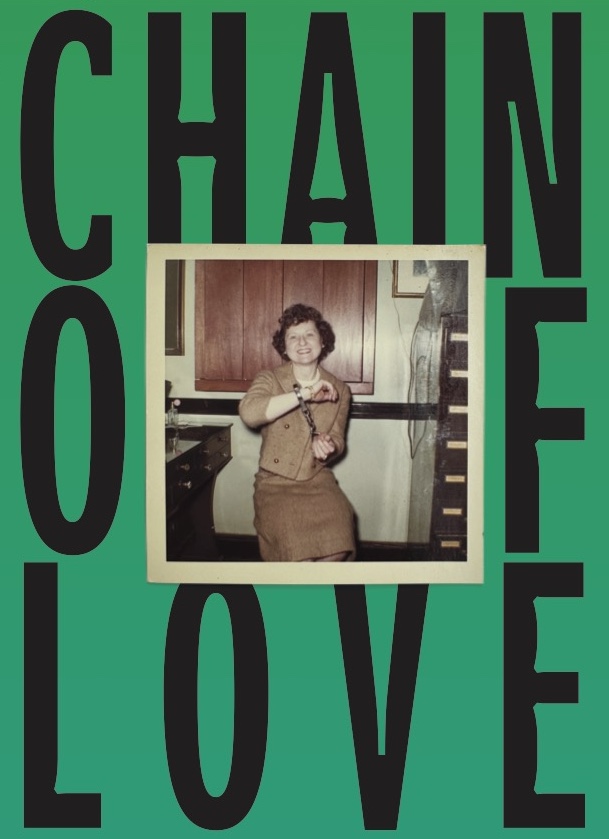
In a shadowed corner of a 1960s home office, a woman known only as Florence staged an intimate photographic ritual. Bound in vintage cuffs, posed amid a filing cabinet and bare desk, Florence created over three hundred annotated images spanning decades—a systematic documentation where cataloging itself became the artistic act.
For Chain of Love in Venice, Paul Graves transforms Joystick into Florence’s power stage, examining her archive through the procedural lens of vernacular photography. In the installation, industrial filing cabinets elevate Florence, allowing her to fully emerge, leaving the viewer caught between voyeur and witness.
Florence’s expressions range from choreographed smiles to meditative absence. What some might dismiss as fetishism reveals a deeper impulse: Florence was an avid collector. Darby Handcuffs, Cobbs, Tower Bean—she inscribed model names, years, and dates on the back of each image with taxonomic precision. Her passion for antiquated police restraints transcended erotics, preserving a metanarrative of control and collection.
Philosophers have long interrogated our compulsion to possess, arrange, and archive the material world. As Jean Baudrillard writes in The System of Objects, “Every object has two functions—to be put to use and to be possessed…” Once collected, objects shed function and become extensions of the self. In Florence’s case, the restraints that confined her body liberated her identity, inverting the relation between possessor and possessed.
Chain of Love transcends objecthood. Through fragmentation, Florence achieves totality: simultaneously collector and collected, dominant and submissive. It becomes a dialectical image in the Benjaminian sense, where past and present power relations interlace.
Graves discovered an anonymous archive made by a woman we know nothing about. Decades later, he recontextualizes her private ritual as public architecture. The archive becomes immersive, experiential, alive. Florence becomes icon and enigma—uncategorized and unclaimed—while Graves asks the ontological question: Are we chained to what we love?
Florence lives in all of us. We are chained to what captivates us, both anchored and freed by our peculiar passions. Life unfolds as a beautiful, absurd cycle of return—of love and loss. We arrange and rearrange our props in an elaborate theater of self, returning again and again, lip-locked to that sweet taste of metal.
— Tess Gruenberg


